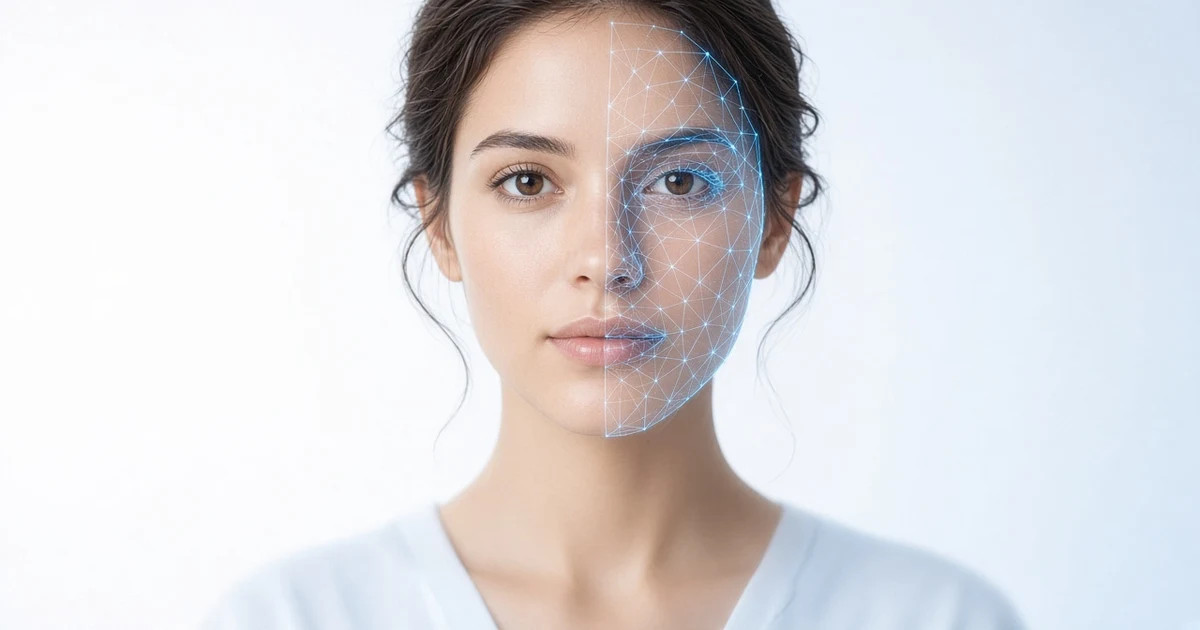
What is a deepfake? AI-made video, image or audio of a real person saying or doing what they never did. Learn the signs. Try DeepWall free.
A video of a chief executive announcing a surprise deal. A voice message from a manager asking for an urgent payment. Each of these can now be produced with AI, and each is a deepfake. This guide explains what a deepfake is, how deepfakes are made, the main types you will come across, why they matter for people and organizations, and what you can do to check and respond to one.
What is a deepfake?
A deepfake is a video, photo or audio recording of a real person that looks or sounds genuine but has been created or altered with artificial intelligence, usually to show that person saying or doing something they never said or did. The U.S. Government Accountability Office (GAO) describes the underlying technology as able to replace faces, manipulate facial expressions, synthesize faces and synthesize speech.
The word itself is a blend. As the U.S. Department of Homeland Security explains, "deepfake" combines deep learning, the type of AI used to generate the content, with fake.
Not every edited image is a deepfake. Cropping a photo, adjusting colors or cutting a video for length are ordinary edits. What makes something a deepfake is that AI has been used to fabricate a person's likeness or voice in a way that is meant to pass as real.
How are deepfakes made?
Deepfakes rely on artificial neural networks: computer systems that learn to recognize patterns in data. According to the GAO, building a deepfake photo or video typically involves feeding hundreds or thousands of images into a neural network, training it to identify and reconstruct patterns, usually faces. Once trained, the model can generate new frames of that face, place it onto another person's body, or make it move and speak in new ways.
Voice deepfakes work on the same principle. A model learns the characteristics of a person's voice from recordings and then produces new speech in that voice. Because executives, speakers and creators publish a lot of video and audio, there is often plenty of public material for these tools to learn from.
The main types of deepfakes
Deepfakes come in several forms. Knowing the differences helps you decide what to look for and which check to run.
Face-swap videos
A real person's face is placed onto someone else's body in a video. The GAO describes face swapping as one of the two most common deepfake video techniques.
Facial manipulation and lip-sync
Instead of replacing the face, the model changes what it does: the expressions of one face are imitated by another, or the mouth is re-animated so the person appears to say new words. This is often paired with a cloned voice.
Fully AI-generated video
Some videos are not edits of real footage at all. Every frame is produced by a text-to-video or image-to-video model, sometimes showing a recognizable person in a scene that never happened.
Voice clones and audio deepfakes
Synthetic speech that sounds like a specific person. The FBI has warned that criminals use AI-generated audio to impersonate public figures or relatives in order to request payments, and that cloned voice clips have been used in attempts to access bank accounts.
AI-generated and face-swapped images
Still images created by AI image generators, or real photos with a face replaced. The FBI notes that criminals use AI-generated images for fake social media profile photos, fraudulent identification documents and fake endorsements by celebrities or social media personas.
Are all deepfakes harmful?
No. The same technology has legitimate uses. The GAO points to films that used it to show characters as they appeared when younger, and to retailers that let customers try on clothing virtually. Consent and disclosure are what separate these uses from abuse.
The GAO also notes, however, that deepfakes are more commonly used for exploitation, and that there is concern about their use for disinformation, from influencing elections to undermining public trust in legitimate evidence. Synthetic media is not illegal in itself, as the FBI points out, but it can be used to commit crimes such as fraud and extortion.
Why deepfakes matter for executives, public figures and brands
A face and a voice carry authority. When they belong to a chief executive, a founder or a well-known spokesperson, a convincing fake can move money, mislead customers or damage a reputation before anyone has time to question it. Public advisories describe several patterns:
- Fake endorsements and investment scams. Singapore's Cyber Security Agency (CSA) reported deepfake videos of the country's Prime Minister and Deputy Prime Minister in December 2023 that appeared to promote cryptocurrency and investment schemes.
- Impersonation on live video calls. The FBI warns that criminals generate video for real-time chats with alleged company executives, law enforcement or other authority figures. The CSA describes a February 2024 case in which a finance worker at a multinational firm was tricked into paying US$25 million after scammers used deepfake technology to pose as the company's chief financial officer on a video call.
- Cloned voices requesting money. Short audio clips in a familiar voice, framed as an emergency, are used to pressure people into paying quickly.
- Fabricated statements. A clip that puts out-of-character words in a leader's mouth can spread across social platforms faster than a correction.
For organizations, the risk is not only the person shown. Staff, investors and customers who trust that person's face and voice are the ones being deceived.
How to tell if something is a deepfake
There is no single giveaway. Researchers behind the MIT Media Lab's Detect Fakes project stress that there is no single tell-tale sign, but they suggest paying close attention to the face, skin, eyes and eyebrows, glare on glasses, facial hair, moles, blinking and lip movements. Singapore's CSA recommends a three-step approach: assess the message (its source, context and aim), analyse the audio-visual elements, and authenticate the content using tools.
In practice, start with context. Ask where the content came from, whether the claim makes sense, and whether it is pushing you to act urgently. Then look and listen closely: blurred edges around the face, unnatural blinking, lighting that does not match the scene, and lips that drift out of sync with speech are all worth a second look. For a step-by-step checklist, read our guide on how to spot a deepfake video.
How deepfake detection works
Detection tools use AI to look for traces that generation models leave behind. The GAO describes methods that analyze videos for digital artifacts or details that deepfakes fail to imitate realistically, such as blinking or facial tics. Results are probabilities rather than proof, so a detector is best used as one signal alongside source checks.
A second approach is provenance: recording where content came from and how it was edited. The Coalition for Content Provenance and Authenticity (C2PA) publishes an open standard called Content Credentials for this purpose, which it compares to a nutrition label for digital content. When a file carries Content Credentials, you can inspect its history.
DeepWall offers free tools to check a file you already have:
- The free deepfake image detection checker estimates whether a JPG, PNG or WEBP image is AI-generated or a face swap.
- The free deepfake video detection tool lets you upload a short clip (MP4, MOV or WEBM, up to 30 seconds and 50 MB) to check for AI-generated frames and face swaps.
- On the deepfake audio detection page you can upload an MP3, WAV, M4A, OGG or FLAC file of up to 25 MB.
A one-off check only helps with content you have already seen. To find fakes you have not seen yet, DeepWall's deepfake detection software monitors newly uploaded videos on YouTube, X, TikTok, Facebook, Instagram, Reddit and news sites with embedded video for the faces and voices you enroll, and alerts you when it finds a likely match, typically within minutes of detection.
What to do if you find a deepfake of you or your company
- Do not share it further. Singapore's CSA advises refraining from sharing dubious content with others.
- Preserve evidence. Save the URL, the account that posted it, the date and time, and a copy or screen recording.
- Verify through a trusted channel. If the content shows someone you know, contact them directly using details you already have. The FBI suggests hanging up and calling back on a number you have researched yourself, and agreeing on a secret word or phrase with family.
- Report it to the platform. Use the platform's own reporting tools; the CSA advises reporting suspected scam content to the platform's administrator.
- Warn the people who might be targeted. Tell finance, communications and leadership teams so nobody acts on a fake instruction.
- Report fraud to the authorities. In the United States, the FBI asks victims of financial fraud schemes to file a report with its Internet Crime Complaint Center (IC3).
On DeepWall's Professional and Executive plans, you can export evidence and use takedown templates to report a deepfake to the platform hosting it; removal decisions are made by each platform.
Protect your face and voice before a fake spreads
The FBI notes that generative AI reduces the time and effort criminals need to deceive their targets, and people with a lot of public video and audio give these tools plenty to learn from. Learning the signs helps, and so does having something watch for you. DeepWall plans start at $49 per month, and every plan includes a 30-day free trial with no credit card required. Start your free trial or try the free image checker now.
Frequently asked questions
What is a deepfake in simple terms?
A deepfake is a fake video, photo or audio clip of a real person made with AI so that it looks or sounds real. It usually shows the person saying or doing something they never said or did.
Why is it called a deepfake?
The term combines "deep learning", the type of AI used to create the content, with "fake".
Are deepfakes illegal?
Creating synthetic media is not illegal in itself, but deepfakes can be used to commit crimes such as fraud, extortion and impersonation. Laws differ by country, so check local rules or get legal advice for a specific case.
Can deepfakes be detected?
Often, yes. Close viewing can reveal signs such as unnatural blinking, blurred face edges or poor lip sync, and AI detection tools look for artifacts that generation models leave behind. No method is perfect, so combine detection with checks on the source and context.
How can I check whether a video or image is a deepfake?
Start by finding the original source and checking whether trusted outlets report the same thing. Then run the file through a detector: DeepWall's free image checker and video detection tool accept uploads with no sign-up.