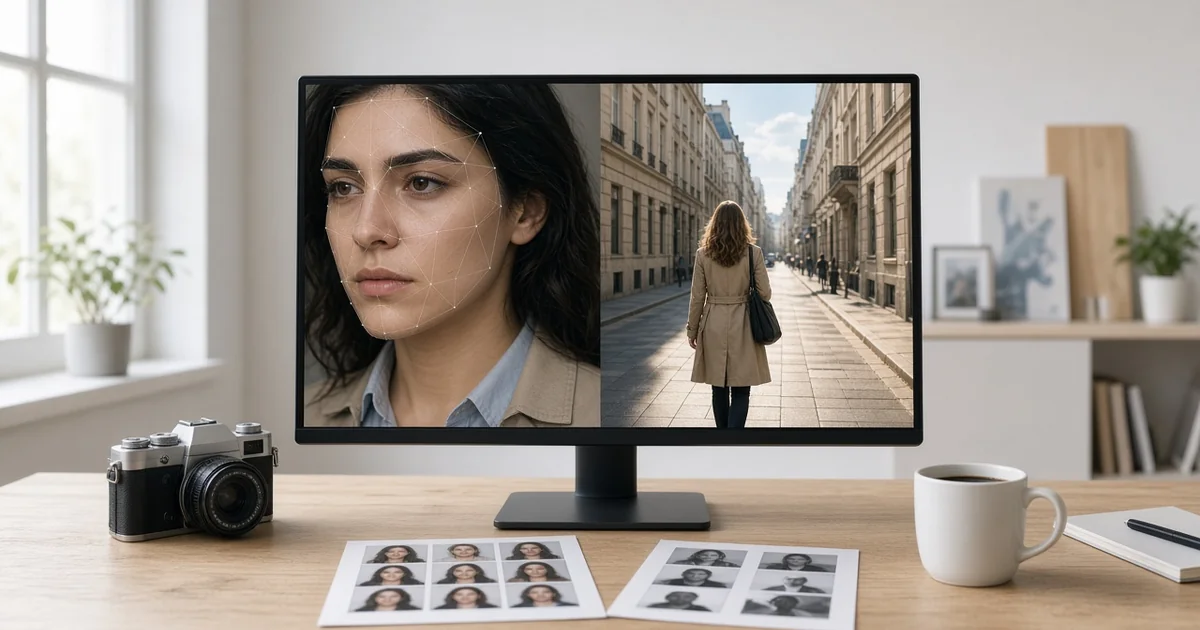
What's the difference between AI-generated video and a face-swap deepfake? One is made from scratch; the other uses real footage. Here's how to tell.
Two clips can look equally real and still be fake in different ways. In one, a real video of a person has had someone else's face placed onto it. In the other, no camera captured that scene at all: a model generated the picture, the motion and often the voice from a prompt or a still image. People call both of these a deepfake, and in everyday use that is fair enough. For checking a file, and for understanding what a detector is actually scoring, the difference matters. This guide explains the difference, where lip-sync and expression fakes sit in between, and how to think about a clip you are unsure about. It is not a frame-by-frame spotting checklist; for that, use our guide on how to spot a deepfake video. For how the underlying models work, see how do deepfakes work.
The short answer
A deepfake face swap starts with real footage. A model learns one person's face, then paints that face onto another person in an existing video, frame by frame, so that the body, the room and the camera movement are usually genuine. An AI-generated video is synthesized. A generative model produces new frames from a text prompt, a reference image, or both, without that scene having been filmed in that moment.
The U.S. Government Accountability Office (GAO) has long treated face swapping as one of the two common deepfake video techniques, alongside facial manipulation, in which the model changes what an existing face does rather than whose face it is (GAO, February 2020). In later work, it also described generative AI systems that can create new images, audio or video from a text prompt by learning patterns from large amounts of training data (GAO, June 2023). Both outputs are synthetic media. They are not made in the same way, and they do not leave the same traces. You can call both kinds a deepfake and still ask a more precise question: are you looking at a swapped identity on real footage, a real face with a new performance, or a scene that was never filmed?
What a deepfake face swap actually is
In a face swap, there is almost always a host video: real footage of a person moving, talking or sitting in a room. The identity in that footage is replaced. As the GAO outlines, the maker collects examples of the face that will be inserted, often from public talks and social posts; a model learns to reconstruct that face; and for each frame of the host video it generates a new face that follows the host's pose, then blends it in at the hairline, jaw and ears. A cloned voice, or a separate lip-sync step, is often added so the person appears to say new words.
Two consequences follow. First, much of what you are looking at may be real: the room, the body, the lighting, even the rhythm of the original speech. That is why a swap can survive a casual glance. Second, the hard work is at the join. When these fakes give themselves away, it is often at the edge of the face, or in a mouth that does not quite belong to the rest of the head. Those signs are getting harder to see as the blending improves. Face-swap stills work on the same principle, which is why a swapped profile photo can look more natural than a fully invented one. For still-image checks, see our guide on how to tell if an image is AI-generated.
What fully AI-generated video is
Fully generated video does not start from a filmed scene that is then edited. A generative model, trained on large amounts of video and image data, produces new frames that match a prompt or a reference. The people, the camera moves, the weather and the room can all be invented. Fake clips of a recognisable person, invented events, and promotional videos that never happened fall into this group.
The U.S. Department of Homeland Security notes that the word "deepfake" itself combines deep learning, the type of AI used to generate the content, with fake (DHS). In that broad sense, a generated clip of a real person is a deepfake too. The important distinction is the source: nothing in that scene was captured by a camera at the time the clip claims to show. Because the whole frame is synthesized, the weak points are different from a swap. Instead of a seam around the face, you may see problems in the physics of the scene, in how hands and objects behave, in the way motion continues from one moment to the next, or in a person who looks almost right but cannot be placed in any real recording. As models improve, those problems shrink. The GAO has already cautioned that current detection methods may not be accurate in real-world conditions, and that generation methods keep adapting to detectors (GAO, March 2024).
The in-between: lip-sync, puppets and expression fakes
Not every manipulated video replaces the face, and not every generated video invents the entire scene. The GAO describes facial manipulation as the other common video technique: the model changes what an existing face does, rather than whose face it is. The mouth may be re-animated so the person appears to say new words, often with a cloned voice. These fakes can be more confusing than a full swap, because the identity is the real one. It really is that executive's face, in that office. What has been fabricated is the speech or the expression.
There are also hybrids. A generated person can be composited into a real background. A real face can be tracked onto a generated body. A short generated talking-head can be dropped into a video call, which is the sort of use the FBI has warned about when it described criminals generating videos for real-time chats with alleged company executives (FBI IC3, December 2024). In practice, you may not be able to tell which recipe was used. You can still decide what, if anything, in the file you should trust, by asking a narrower question than "is this a deepfake?": has the identity been replaced, has the performance been altered, or has the whole scene been generated?
A side-by-side view
Here is a practical way to keep the categories straight. This is a guide to how the file was made, not a verdict on any one clip:
- Face-swap deepfake. Starts from real footage. The body, setting and camera are usually genuine. The identity of the face is not. When traces appear, they often sit at the join around the face and in the match with the voice.
- Facial manipulation or lip-sync. Starts from real footage of the same person. The identity is genuine. The words, the expression, or both, have been altered.
- Fully AI-generated video. Does not start from that filmed scene. People, places and motion can all be synthesized from a prompt or a reference image. There may be no earlier recording of the same event to find.
Ordinary video editing — a crop, a colour grade, a cut for length — is none of these. What makes something a deepfake, in the sense used here, is that AI has been used to fabricate a likeness, a performance, or a scene so that it is meant to pass as real. A clip described only as "AI" may also be a simple enhancement, such as a lighting clean-up; those edits are not what this article is about.
Why the difference matters
It changes what a detector is scoring. A system trained to find identity swaps is not doing the same job as a system trained to recognise fully generated frames. DeepWall's free image checker reports those questions separately: one score for AI generation, and another for face swapping. A still can be high on one and low on the other.
It also changes what counts as evidence. If a face has been swapped onto real footage, something did happen in front of a camera — just not to the person who now appears there. If the whole video is generated, the event itself may never have taken place. That distinction can matter for journalism, for legal evidence, and for a company deciding whether a clip of its chief executive is a distorted record of a real meeting or an invented one. A face swap, or a generated talking head, can put a known leader into a meeting they never joined. A fully generated scene can invent a location, a crowd or a product demonstration. Both can be paired with a cloned voice. The risk is similar: a familiar face is used to create trust. The file you are asked to trust may still be different in kind.
How to think about a clip you are unsure about
Start with the source and the claim, not the pixels. Who first posted the video? Does it appear on official channels? Is it pushing you to pay, share, or amplify something urgent? Singapore's Cyber Security Agency recommends assessing the message — its source, context and aim — before analysing the pictures, and then authenticating the file with tools where you can (CSA, March 2024).
Then try to classify the clip in the terms above. If it looks like a real room with a face that might have been replaced, you are in face-swap or lip-sync territory. If the whole scene looks produced, and you cannot find any earlier recording of the same event, it may be fully generated. You will not always be able to decide, and you should not pretend otherwise. For the visual and audio signs to inspect once you have that context, use our guide on how to spot a deepfake video. This article will not repeat that checklist. A close look is still useful, and it is still not proof. The GAO has reported that detection methods can fail in real-world conditions, and that older hallmarks, such as abnormal blinking, are expected to fade as generators improve.
Provenance labels can help when they are present. Content Credentials, an open standard from the Coalition for Content Provenance and Authenticity (C2PA), record a file's origin and edits. Some platforms have also announced metadata tags or watermarks for AI-generated content, as the CSA has noted. Most clips online have no such credentials, and platforms often strip metadata on upload, so their absence tells you very little.
How DeepWall can help — and what it cannot do yet
If you have a still frame, a screenshot or a photograph you want to test, DeepWall's free deepfake image detection checker is the tool that works today. It accepts JPG, PNG or WEBP files of up to 4 MB, with no sign-up, and returns two scores from 0 to 100%: one for AI generation and one for face swapping, and, when it can, the AI generator the image most likely came from. That split is the point of this article in tool form: the two questions are not the same. Daily limits apply (5 image checks per visitor). Images are analysed in memory and not saved. Treat each score as a probability, not a verdict.
If you have a video file, you can upload an MP4, MOV or WEBM clip of up to 30 seconds and 50 MB on the deepfake video detection page, or use the video tab on the deepfake detector hub. Automated analysis of uploaded video is still in development, so that checker does not yet return a real-or-fake score. The file is deleted after the upload. For now, extract a clear still frame, run the image checker, and combine that with the source checks in the spotting guide.
A one-off check only helps with a file you already have. If the risk is a face-swapped or generated video of you or your leadership team appearing somewhere you are not looking, that is a monitoring job. DeepWall's deepfake detection software is the paid product for that job. You enroll a person with 3 to 5 photos and a 30-second voice sample. DeepWall then checks newly uploaded videos on YouTube, X, TikTok, Facebook, Instagram, Reddit and news sites with embedded video, matching faces and checking the audio for a cloned voice. When a video crosses your match threshold, you get an alert, typically within minutes of detection. Professional and Executive plans add evidence export and takedown templates; removal decisions are made by each platform. Plans start at $49 per month, with a 30-day free trial and no credit card required. Start your free trial, or try the free image checker first.
Frequently asked questions
Is a face-swap video a deepfake, or only fully AI-generated video?
Both are commonly called deepfakes. A face swap alters real footage by replacing the identity. Fully generated video invents the frames themselves. The GAO treats those methods as related, but distinct, ways of making synthetic media.
Can a fully AI-generated video still show a real person?
Yes. If a model has seen enough images or footage of someone, it can generate new video that looks like that person in a scene that never happened. The harm — a fake statement or a fake event — can be the same as a face swap.
Which kind is easier to detect?
There is no reliable rule. The GAO reports that detectors can fail in real-world conditions and that generators adapt to them. Use source checks, a close look and a detection score together, and do not treat a clean result as proof that a clip is real.
How can I check whether a video is a face swap or AI-generated?
Start with the source and the claim, then look at a clear still frame. DeepWall's free image checker reports separate scores for AI generation and for face swapping. The free video upload does not yet return a score. For visual checks, see how to spot a deepfake video.
Does the difference matter if I just want to know whether to trust the clip?
For a yes-or-no decision about trust, you do not need a perfect classification. If the source is weak, the claim is extraordinary, or a check flags either generation or a swap, do not treat the file as a record of what a real person said or did.